


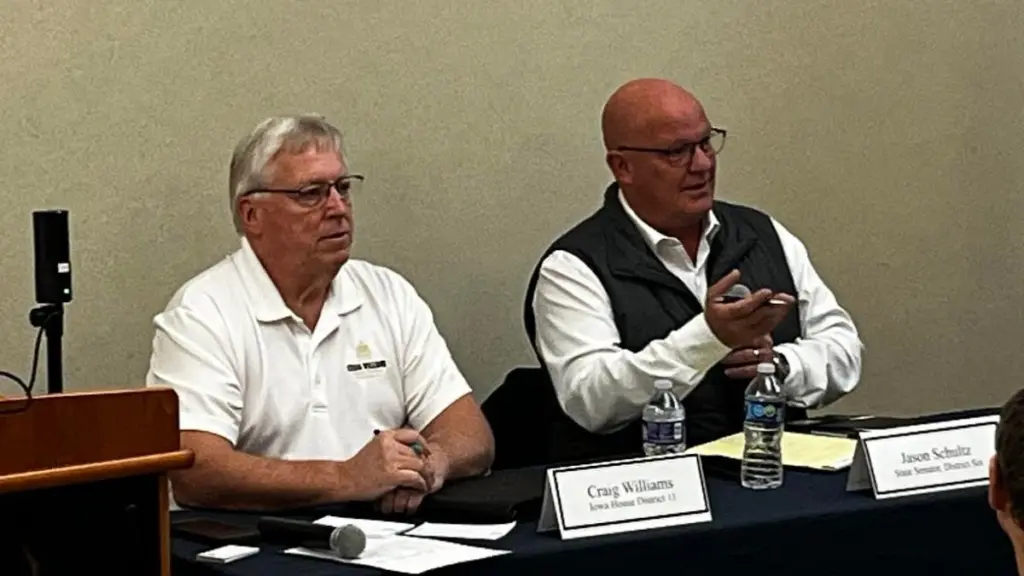
Pictured: Rep. Craig Williams (left) and Sen. Jason Schultz (right) speak during the Jan. 24 Legislative Forum at St. Anthony Regional Hospital
The future of Iowa’s property tax code is still undecided, but local legislators are sure of one thing: there will be some form of change coming by the end of the 2026 Iowa Legislative Session. District 6 Senator Jason Schultz (R-Schleswig) and District 11 Rep. Craig Williams (R-Manning), commented on the issue during Saturday’s Legislative Forum, which is put on by the Carroll Chamber of Commerce and Carroll County Growth Partnership (CCGP) and was hosted by St. Anthony Regional Hospital. The Senate and the House both have their own proposals, as does Gov. Kim Reynolds, along with another plan put forward by Iowa Democrats. Schultz says it’s still very early in the process, and he isn’t sure what he favors quite yet.
Each proposal has its pros and cons, and Schultz says the challenge lies in foreseeing the unintended consequences of a change. However, the central theme is clear, and that is to widen the tax base and distribute the cost of government services.
One idea is to raise the Local Option Sales Tax (LOST) from one percent to 1.5 percent to offset property taxes. Some attendees expressed concerns about the potential impact of growth caps on public schools, whose funding comes primarily from the state and local property tax revenues. Williams says two of the proposals he’s seen have more leeway for school districts.
Other proposals include freezing property tax bills for Iowans, limiting tax increment financing (TIF) districts, and granting Iowans a 50 percent homestead exemption on their home’s value. Williams adds that Iowa’s current tax code is the result of decades of the legislature making tweaks here and there, resulting in a convoluted mess that is difficult for Iowans to navigate. He says the House and Senate, Democrats and Republicans, will need to be creative and open to new revenue streams, such as online gambling.
It is likely that the debate on Iowa’s property tax system will last through much of the session’s timetable, as it has been a high priority for GOP lawmakers for several years.