


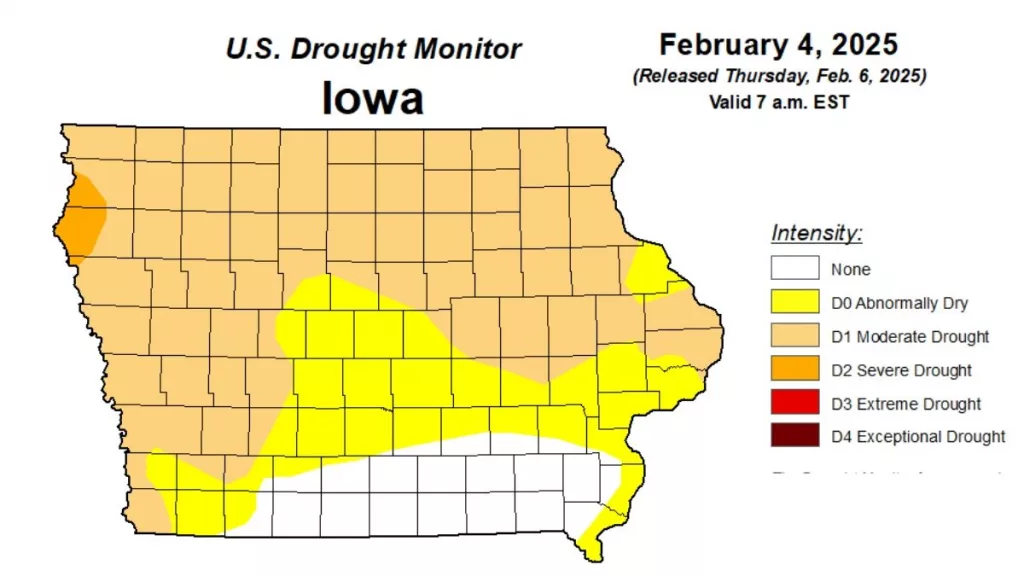
Despite below-average precipitation in January, drought conditions across the state remained stable, according to the latest Iowa Water Summary Update. January’s preliminary statewide precipitation totaled 0.32 inches, or 0.65 inches below normal. While January is typically Iowa’s driest month, above-average rainfall in November and December helped prevent drought conditions from worsening. As of Jan. 31, the Iowa Drought Plan showed conditions holding steady, with the entire state under a normal drought watch designation. However, the U.S. Drought Monitor reports that nearly three-quarters of Iowa remains abnormally dry or in drought, with northwest Iowa the only locale experiencing severe drought. Nearly all of the listening area is classified as D1, or “moderate drought,” excluding the eastern half of Greene County and the southeastern corner of Guthrie County with D0, or “abnormally dry” conditions. DNR Environmental Specialist Jessica Reese McIntyre says, “Although January was unseasonably dry, the above-average precipitation totals in November and December helped maintain stable drought conditions going into the driest month of the year. The National Weather Service precipitation outlooks are promising for the eastern half of the state, which may receive slightly above-normal precipitation, while western Iowa could see average precipitation levels.” The report is prepared monthly by technical staff from the Iowa Department of Natural Resources (DNR), the Iowa Department of Agriculture and Land Stewardship, IIHR—Hydroscience and Engineering, and the U.S. Geological Survey, in collaboration with the Iowa Homeland Security and Emergency Management Department. The complete January report is available using the link included below.
_____